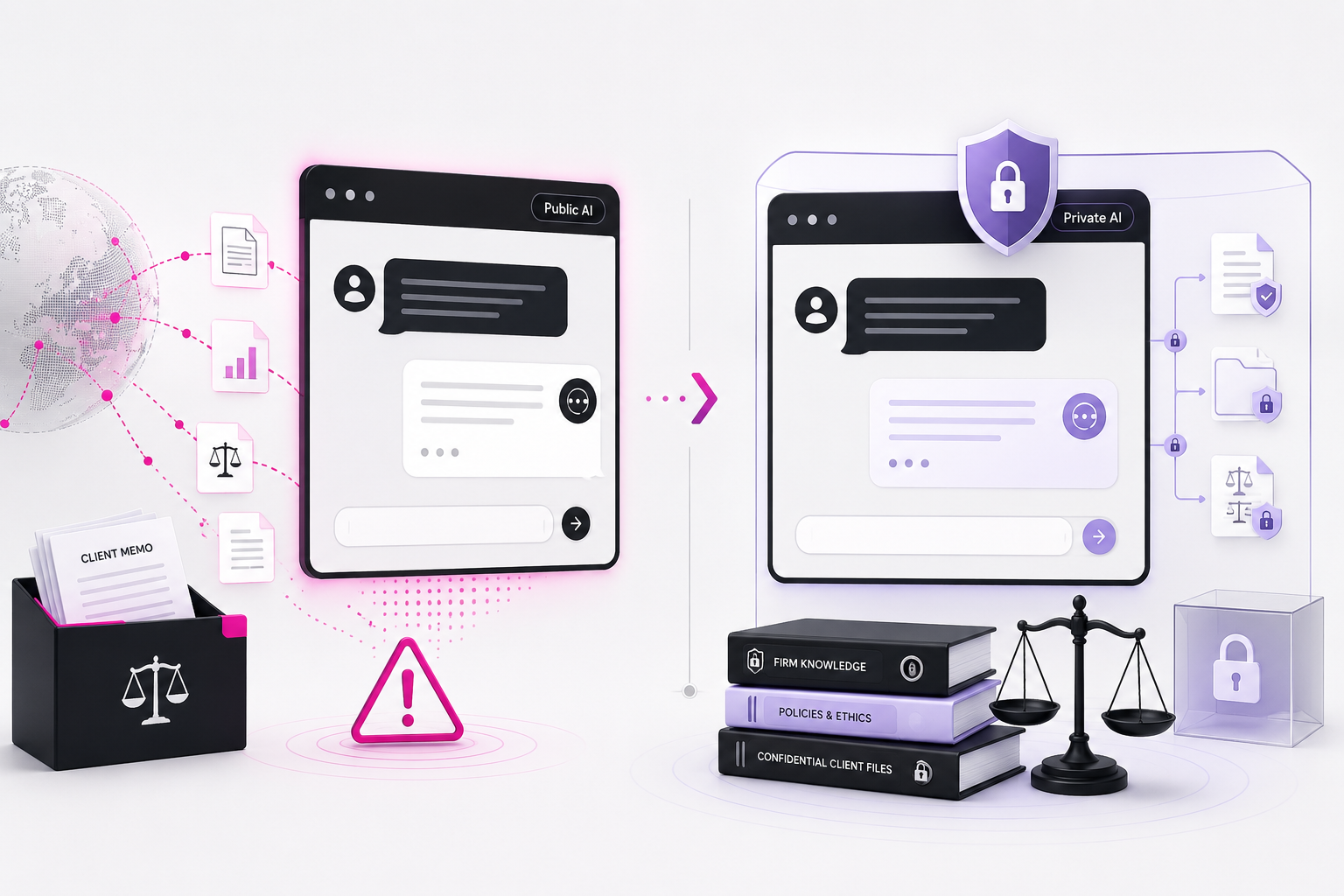
An attorney pulls up her AI chat at 7am. She types "Help me draft a pre-hearing brief for Mr. Garcia." The AI responds with a perfectly serviceable generic brief template. It has no idea who Mr. Garcia is. It does not know he has lumbar DDD and major depressive disorder. It does not know his alleged onset date is contested. It does not know which judge will hear the case. It does not know what the firm has argued in similar cases before. The attorney sighs, opens another tab, and starts pasting in context.
This is how most legal AI works. Every conversation starts cold. The lawyer plays the role of a translator, converting the messy reality of an active case into prompts the AI can understand. It is not that the AI is bad at drafting. It is that the AI does not know what it is drafting about.
There is a name for what is missing. Matter-aware AI. It is the difference between a tool that helps you and a tool that knows you.
What matter-aware AI actually means
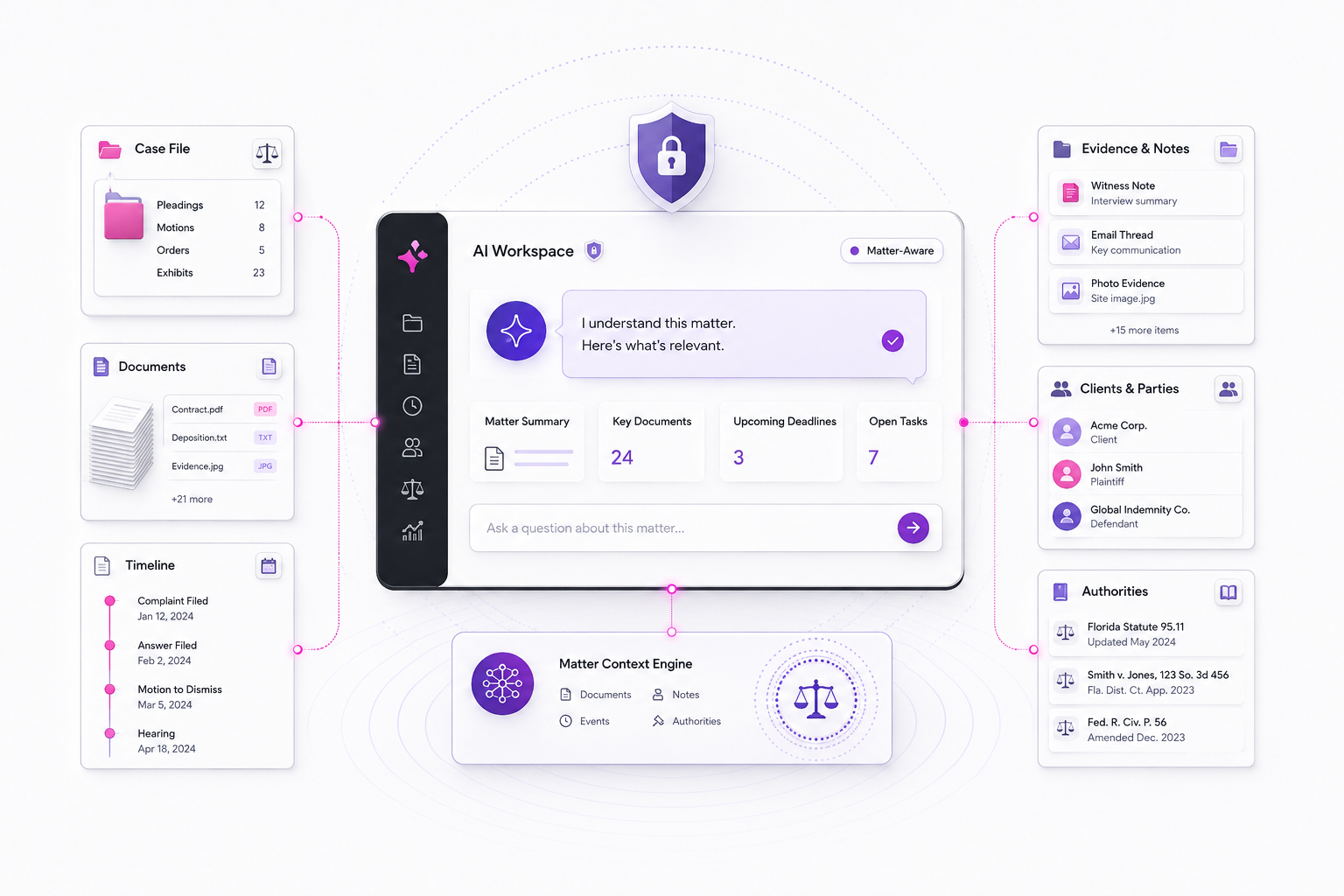
A matter, in legal practice, is the umbrella for everything tied to a specific representation. The client. The facts. The documents. The timeline. The opposing counsel. The judge. The jurisdiction. A matter is the unit of work a law firm organizes itself around.
Generic AI does not have a concept of a matter. It treats every chat as an isolated event. You can paste in case facts at the start of each conversation, but the AI has no persistent understanding that the conversation is about a specific case with specific documents and a specific history.
Matter-aware AI flips this. You pin a matter to the conversation. From that moment forward, the AI treats every question as being asked in the context of that specific case. The client's name is known. The practice area is known. The case facts you have entered are known. The documents assigned to the matter are prioritized in retrieval. Documents you upload during the conversation get filed to the matter automatically.
The interface is simple. The behavior change is significant.
Why this matters more than people think
The case for matter-aware AI is not about saving keystrokes. It is about reducing the chance of errors that compound through a brief, a hearing prep memo, or a client letter.
Consider what happens when an attorney is working on three active matters in the same week. Matter A is an SSDI case with a sedentary RFC argument. Matter B is an immigration case with a complex asylum claim. Matter C is a personal injury case with a contested causation issue. Without matter context, the AI receives three disconnected conversations. The attorney has to manually flag context every time. The risk is not that the AI confuses Matter A's facts with Matter B's. The risk is that the attorney, exhausted, accidentally pastes a fact from Matter C into a prompt about Matter A and does not catch it.
Matter-aware AI eliminates that class of error. The pinned matter scopes the conversation. The AI does not have access to other matters' facts during that chat. The attorney does not have to remember which case the AI is currently helping with, because the AI knows.
That is the floor. The ceiling is higher.
Retrieval, but with context
The technical concept underneath matter-aware AI is called retrieval-augmented generation. It is the way modern AI systems pull relevant information from a knowledge base to answer a question. You ask a question. The system finds the most relevant documents. The AI uses those documents to construct the answer.
The problem with naive retrieval is that it pulls from the whole library every time. If your firm has 5,000 closed cases, every query searches all 5,000. Most of the time, that is wasteful. If you are working on Smith's lumbar case, you do not need the system pulling up an immigration brief from three years ago just because it shares a few keywords with your question.
Matter-aware retrieval narrows the search. When a matter is pinned, the documents assigned to that matter rise to the top of every search. The system still searches the whole library, but it weights the active matter's documents most heavily. The answers it produces are anchored to the case the attorney is actually working on.
This sounds technical because it is. But the user-facing effect is straightforward: the AI gives better answers, faster, with fewer wrong-document detours.
The AI catches what the attorney forgets
The hardest part of any tool is remembering to use it correctly. If matter-aware AI requires the attorney to remember to pin every conversation, it will fail in practice. Lawyers are busy. Pinning gets forgotten. Then the value disappears.
The fix is having the AI catch the moment the matter context is needed and offer to set it up. A lawyer types "Pull up everything we have on Mr. Garcia's onset date argument." The AI parses the message, identifies "Mr. Garcia" as a client name, and asks: "I see you mentioned Mr. Garcia. Want me to pin the Garcia matter so I can use the full case context?" One tap and the matter is set.
The attorney was already going to ask the question. The AI just removed the step where the attorney had to manage context manually. That is the difference between a feature that gets adopted and a feature that gets forgotten on the second day.
Documents file themselves
Another quiet benefit. When a matter is pinned and the attorney drops a new document into the chat, the document files itself to that matter automatically. No manual tagging. No "remember to assign this to the Garcia case" notification. The context already exists. The system uses it.
This sounds trivial until you imagine the alternative. A paralegal uploads 47 new medical records over the course of a week. Without matter context, each one needs to be manually tagged and filed. With matter context, the paralegal pins the matter at the start of the day, drags files in as they arrive, and the system handles the rest. The end of the week, the matter has a clean, organized document trail. Nobody had to think about taxonomy.
What changes when AI knows the case
Five things look different when an attorney works with matter-aware AI versus generic AI.
The first prompt is shorter. Instead of "I have a client with lumbar DDD and MDD who alleges onset on March 14, 2024, with a sedentary RFC from his treating physician, help me draft a pre-hearing brief," the prompt becomes "Help me draft the pre-hearing brief." The context is already loaded. The AI knows what kind of brief, for whom, with what facts.
The output reads like the firm wrote it. Because the AI has access to the firm's templates, prior briefs in similar matters, and tone profile, the draft comes out sounding like the firm's voice. The attorney still reviews. But the editing pass is lighter.
The citations are real and relevant. Pulled from the matter's actual documents. From the firm's prior work product. Not generated from a probabilistic memory of legal text on the public internet.
The follow-up questions stay in context. The attorney can ask "Now compare this to how we argued the Rodriguez case" without re-explaining anything. The Rodriguez case is in the firm's knowledge base. The AI pulls it up alongside the current matter.
Mistakes get caught earlier. If the attorney references a fact that is not in the case file, the AI can flag it instead of inventing supporting language. "I do not see anything in Mr. Garcia's records supporting that. Should I look in another file?" is a different conversation than the AI confidently producing a paragraph that sounds true and is not.
Who is actually building this
Most legal AI tools on the market today are not matter-aware. They are document search wrappers on top of a large language model. You upload your firm's documents. The AI searches them when you ask a question. There is no concept of a matter, no concept of an active case context, no concept of pinning a conversation to specific records.
I co-founded DVLP Studio and we build a product called DVLPstudio Legal Intelligence. Matter-aware AI is the core of what the product does. Full disclosure on the bias.
The reason we built it this way is that we spent time with attorneys before writing a line of code. Watching them work. The pattern was the same in personal injury practices, immigration practices, and Social Security disability practices. Lawyers were spending real time re-establishing context for tools that should have known better. A tool that knows which matter the attorney is working on is not a luxury. It is the baseline a legal AI should meet.
For practices that run on case volume and pattern recognition, the value is especially clear. SSD attorneys see the same impairment combinations repeat across hundreds of cases. Without matter context, the AI cannot connect the current case to the firm's history with similar facts. With matter context, the connection is automatic.
What to ask any legal AI vendor
If you are evaluating a legal AI tool right now, these are the questions to ask.
Does the system have a concept of a matter? Not a folder. Not a tag. A first-class concept that scopes conversations and retrieval. If the answer is "we have folders," it is not matter-aware.
Can I pin a matter to a chat? If the only way to give the AI case context is to paste it into every prompt, the system does not have matter context. It has manual context, which the attorney has to maintain.
Does retrieval weight the active matter's documents? If the system searches the whole library equally regardless of what matter is active, the system is not using matter context for retrieval. It is just labeling.
What happens when I upload a document during a pinned conversation? If the answer is "it goes to a general upload queue and needs to be tagged later," the system is not auto-routing uploads to the active matter.
If a vendor cannot answer these clearly, you are looking at a tool that bolted AI on top of document storage, not a tool designed around how lawyers actually work.
The future is matter-aware by default
In two years, all legal AI will be matter-aware. The question is not whether the category exists. The question is which vendor builds it well, which vendor builds it as an afterthought, and which firms adopt the right tool before their competitors do.
If you want to see how matter-aware AI works in practice, get on a call with us. We will load a sample matter, show you the pinning behavior, and let you ask questions the way your attorneys actually do. If DVLPstudio Legal Intelligence is the right fit, great. If not, we will be direct about who else to look at. Either way, you will leave knowing what matter-aware AI actually is, and why your current tool probably is not it.