AI for SSD Attorneys

Your firm has done
this case before.
The AI should know.

Legal Intelligence is a private AI copilot built for Social Security Disability practice. It learns your firm's pre-hearing briefs, RFC analyses, onset date strategy, and ALJ hearing prep. Then it surfaces that institutional memory in seconds, every time you take a new case.

ABA Opinion 512 compliant
Per-firm isolation
No training on your data
The SSD reality

Same case patterns.
Same paperwork. Every time.

SSD practice runs on repetition. The institutional memory of "how we won the last lumbar DDD case" is the most valuable thing a firm has. Most of it lives in old case files no one has time to dig through.

Denial appeals that all look the same
Same denial reasons. Same RFC arguments. Same medical evidence patterns. Each appeal still gets drafted from scratch because no one can find the brief from the closed case 14 months ago.
ALJ hearing prep on a deadline
Hearing's in three weeks. Client has lumbar DDD and major depressive disorder. What's our strongest pre-hearing brief structure for this combination? It's in someone's old case file.
Onset date strategy by feel
The right onset date affects benefit amounts and back pay for years. The firm has nailed this argument before. Reconstructing the analysis from memory each time leaves money on the table.
Medical record review at 11pm
400 pages of treatment records. The associate scans for diagnoses, dates, contradictions, gaps. Two hours later they have a chronology that the AI could have produced in 30 seconds, cited to specific pages.
Mental impairment evidence framing
Mental RFC arguments have specific structure that SSA examiners look for. The firm knows the structure. The associate drafting tonight's case may not. Inconsistent framing means weaker claims.
Vocational expert prep cold
The VE will be asked the same kinds of questions on cross. The firm has effective cross-examination patterns. Each attorney rebuilds them from scratch the night before the hearing.
What it actually does

The work, drawn from
your firm's actual case history.

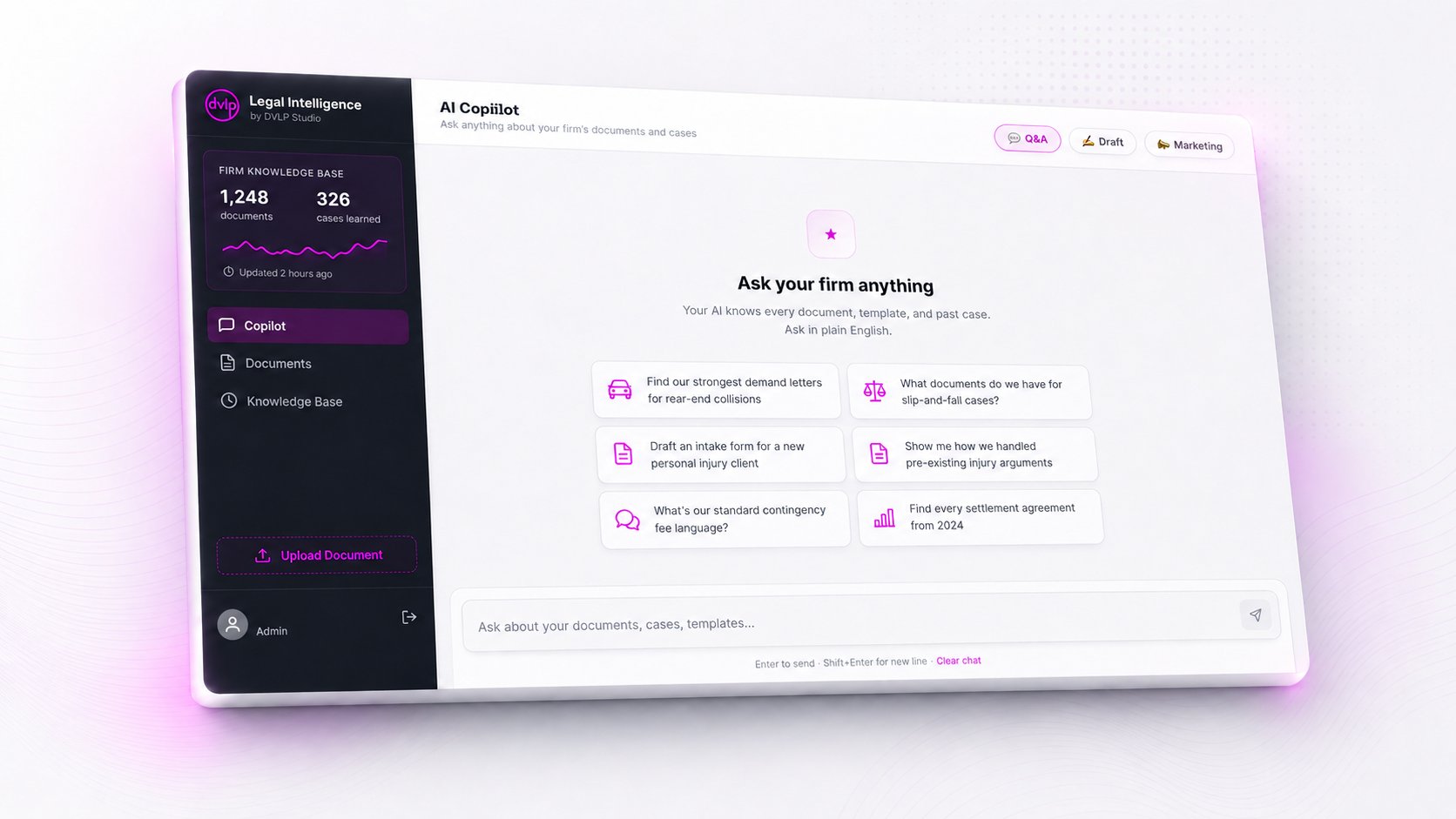
Legal Intelligence loads your firm's pre-hearing briefs, RFC memos, onset date analyses, and hearing prep documents into a private AI. Every output is built from your work — not generic legal templates from the internet.

Pre-hearing briefs

Draft from your firm's strongest briefs.

Pin the matter to your chat. Ask for a pre-hearing brief draft. The AI pulls your firm's template, the relevant medical evidence from the matter's documents, and the case facts you've entered. Output reads like your firm wrote it.

"Draft a pre-hearing brief for lumbar DDD and MDD, sedentary RFC, using our standard structure."
RFC analysis

RFC reasoning that cites your firm's prior work.

For mental RFC, physical RFC, or both. The AI pulls medical evidence from the case file and structures it against the relevant POMS sections and your firm's preferred argument framework. Every claim cited back to specific records.

"Walk me through the RFC analysis for this client's chronic pain claim, citing the strongest evidence."
Onset date strategy

Identify the strongest onset date, fast.

The AI reviews the medical evidence in the case file, identifies dates that anchor a strong onset argument, and surfaces analogous successful cases from your firm's history. The lawyer makes the call. The AI does the research.

"What's the strongest onset date we can argue for this claimant? Pull from our prior similar cases."
ALJ hearing prep

Hearing prep memos in minutes, not hours.

Generate a hearing prep memo that walks through testimony framing, the most likely VE questions, cross-examination patterns from your firm's prior hearings, and the documents to have on hand. All from the firm's case history.

"Prep me for the Smith hearing — testimony framing, likely VE questions, key documents."
Medical record summaries

400 pages of records, summarized cleanly.

Drop the PDF in. Get a chronology of treatment, diagnoses with dates, treating providers, medications, gaps in care, and contradictions flagged for review. Every entry cited to a specific page number. Verifiable in seconds.

"Summarize these records. Flag anything that contradicts the disability narrative."
Cross-case pattern memory

"How did we handle this last time?" — answered.

The firm has fought this fact pattern before. The AI knows where the prior cases are. Ask how the firm handled a similar onset date dispute, a similar impairment combination, or a similar ALJ. You get the actual prior work, with citations.

"Pull every case where we won on a closed period award for an MDD claimant."
How it compares

Built different from
the AI tools you've tried.

Capability
ChatGPT
Generic legal AI
Legal Intelligence
Trained on your firm's documents
No
No
Yes
Knows which case you're working on
No
Limited
Yes
SSD-specific (POMS, HALLEX, Blue Book)
No
Surface-level
Yes
Private instance / no data training
No
Varies
Yes
Output cited to source documents
No
Sometimes
Yes
ABA Opinion 512 compliance documentation
No
Varies
Yes

Get your firm set up on Legal Intelligence.

Tell us a few things about your firm. We onboard new firms personally. Typically about a week from signup to using it daily, but we'll move at your firm's pace if you need longer.

  • Your firm gets a private, isolated instance. No shared infrastructure with other firms.
  • We help you upload your initial document library and configure your firm's tone
  • Full ABA Opinion 512 compliance package, including DPA and sworn declaration template
  • Direct line to the team that built it. Not a generic support queue.
We'll reply within one business day. No automated drip sequence.
Common questions

SSD AI questions, answered.

SSD practice is high-volume, document-heavy, and pattern-based. The same kinds of impairments, the same POMS sections, the same ALJ procedures repeat across hundreds of cases. A firm's institutional memory is most of the value: which arguments worked, which medical evidence patterns won, how onset date was framed. Generic AI ignores all of it. Legal Intelligence is trained on your firm's actual work product.
Yes. Legal Intelligence is configured for SSD practice, including POMS sections, HALLEX procedures, the Listing of Impairments, and ALJ hearing structure. When you draft a pre-hearing brief or RFC analysis, the AI uses these as foundational context, alongside your firm's own templates and case history.
ChatGPT doesn't know your firm. It doesn't know the pre-hearing brief template you've refined over hundreds of cases, your firm's tone, or the arguments that have worked for your specific ALJs. It also won't keep your client information private. Legal Intelligence is a private instance trained on your firm's documents. Your data stays yours and never trains a public model.
Yes. Legal Intelligence is built around ABA Model Rule 1.6 (confidentiality) and ABA Formal Opinion 512 on generative AI. Per-firm data isolation, no training on your data, full audit log, sworn declaration template, and engagement letter language for AI disclosure in client matters.
Typically about a week from signup to using it daily, but we'll move at your firm's pace if you need longer. We set up your private instance, upload your initial document library with you, and configure your firm's tone profile and templates.
We don't publish public pricing yet. We price the value, not a feature list. The best next step is to sign up. We'll be direct about fit and cost on the first call.